
What Is a DeFi Oracle? How Lending Apps Learn a Coin's Price
A lending app needs a coin's price. A DeFi oracle brings that price onto the blockchain. Here is how it works and what to ask.
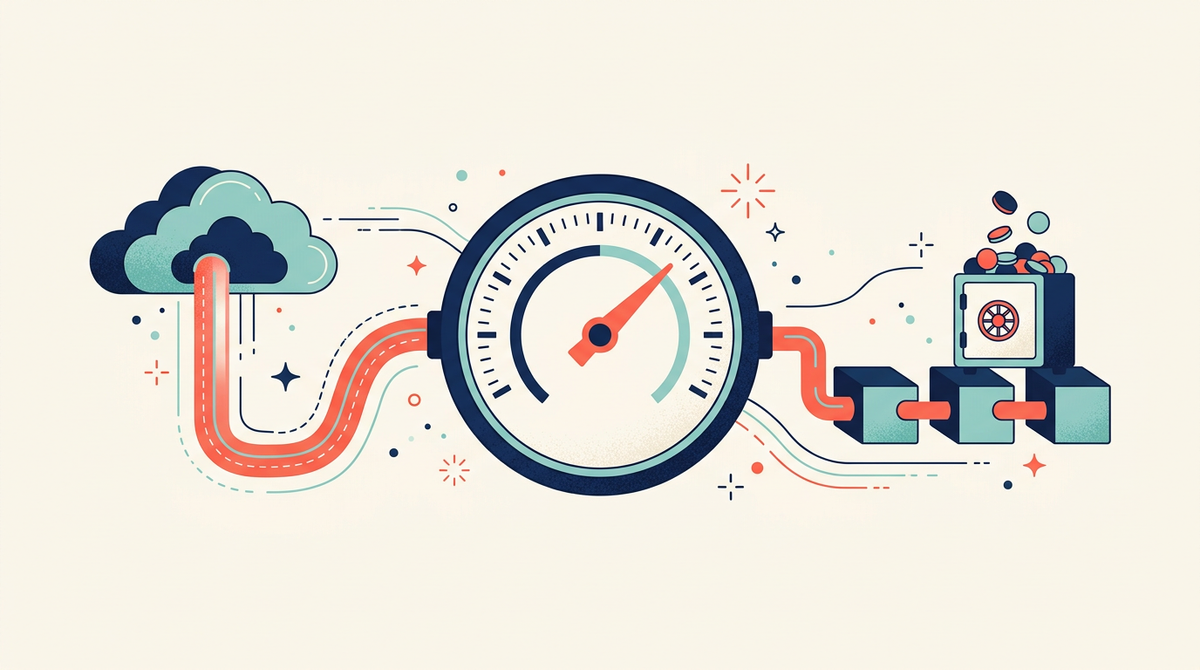
A lending app needs one number to do its job: what your collateral is worth right now. Collateral is the crypto you put up to back a loan. A DeFi oracle is the tool that brings that price to the app.
What an oracle is
Uniswap's documentation describes a price oracle as any tool used to view price information about an asset. It compares this to checking a stock price on your phone.
Chainlink's glossary gives a wider definition. An oracle connects blockchain programs with outside data, which is called offchain data. It usually has two parts. The oracle node is the offchain part. The oracle contract is the onchain part. Other contracts use it to pass and receive data.
Why lending apps need one
Chainlink's documentation says lending and borrowing platforms use its data feeds to judge how much collateral is worth. It names Aave as one example. This article has not checked whether any particular app uses a particular feed today.
Here is a made-up example. Say an app lets you borrow up to 50% of your collateral's value. You deposit coins worth $1,000 at the real price, so you can borrow up to $500. If the app wrongly reads the price as $1,500, it could let you borrow up to $750 against coins that are really worth $1,000. The numbers are only an illustration, not any app's real rule.
One design: many sources, combined onchain
Chainlink's documentation describes how its price feeds work:
- Several operators. Each feed is updated by multiple independent oracle operators. The number differs from feed to feed. If too few of them respond, the feed's latest answer is not updated.
- Several data sources. For crypto prices, the documentation says the data comes from at least three price data aggregators or market data vendors, using exchange data.
- One combined answer. A contract called the aggregator combines the answers and stores the result onchain. Apps read it through a proxy contract, which points to the aggregator. This lets the aggregator be upgraded without interrupting the apps that use it.
The documentation also says these contracts have an owner who can change settings. In its BTC/USD example on Ethereum, the owner is a multi-signature wallet, which needs a set number of approvals to act.
A price feed is not a live stream
Chainlink's documentation says its feeds do not stream data. An update happens in one of two cases, whichever comes first. The first is a price change larger than a set limit, called the deviation threshold. The second is a set amount of time since the last update, called the heartbeat.
The documentation says some heartbeats last several hours. It also says the same asset can have different settings on different blockchains. For that reason, it tells app builders to check the time of the latest answer. If the answer is too old, the app should pause or switch to a backup mode.
Another design: an average over time
Uniswap's documentation describes a different approach. Its v2 and v3 trading pools can record price history, which others can use as an oracle. Its v4 does not have built-in oracle features.
The idea is a time-weighted average price, or TWAP. It is the average price over a set stretch of time. Because it averages, one sudden trade moves it less. Uniswap's documentation says the cost of pushing this price around goes up with the pool's liquidity, meaning the money in it, and with the length of the averaging period. It also says other factors, such as network congestion, can lower that cost.
What can go wrong
Uniswap's documentation says many oracle designs were built one-off, with different levels of security. It says there have been numerous high-profile hacks where the oracle was the main way in. This article has not checked individual incidents.
Chainlink's documentation says low-liquidity assets, which are coins with little trading, are the most open to price manipulation. It also says app developers are responsible for watching their own risks, including market risks and code risks. It names safeguards such as data quality checks and circuit breakers, which pause an action when something looks wrong. A well-built feed does not remove the app's own risk.
Questions to ask before you use a lending app
These questions are ours, based on the ideas above. They are not rules from either source.
- Does the app's documentation name its price source and link to it?
- Does the price come from many sources or only one?
- How often does it update, and what does the app do if updates stop?
- Does the app accept coins that trade very little?
- Who can change the feed's settings?
Some apps show part of this information on screen. Tokenpost reported on Oct. 28, 2026, that the Morpho app shows each lending market's oracle setup. Its report summary says users can compare the displayed oracle price with a reference figure and see the value secured across markets.
Limits of this explainer
This is a general explainer. It does not say which oracle any app uses today, and it does not compare oracles. The explanation relies on documentation that Chainlink and Uniswap wrote about their own products. Documentation changes, so read each app's own documents before you rely on them.
Sources
- Chainlink documentation: Glossary (oracle definition)
- Chainlink documentation: What are Chainlink Data Feeds?
- Chainlink documentation: Decentralized Data Model
- Chainlink documentation: Data Sources
- Chainlink documentation: Developer Responsibilities
- Chainlink documentation repository license: MIT License, copyright 2026 SmartContract Chainlink Limited SEZC
- Uniswap documentation: v2 Oracles
- Uniswap documentation: v3 Price Oracles
- Uniswap documentation repository license: MIT License, copyright 2026 Uniswap Labs
- Tokenpost: Morpho App Shows Oracle Configuration for Each Lending Market (Oct. 28, 2026), news summary via Crypto News API
Disclosure and Disclaimer: This article is a general explainer based on the public documentation of two DeFi projects, Chainlink and Uniswap, as published in their open-source documentation repositories on Nov. 17, 2026. It also mentions one news report, dated Oct. 28, 2026, about the Morpho app, based on a summary supplied through the Crypto News API. It does not review or test any specific lending app, price feed or token, and it does not say any oracle is safe or unsafe. DeFi carries smart contract, price feed and loss risks, including loss of funds. The featured image is an AI-generated illustration. This article is not financial, legal, or investment advice. AI-assisted research and original article writing, links back to sources for proper attribution. Cited sources, not AI alone, support article writing and factual claims.